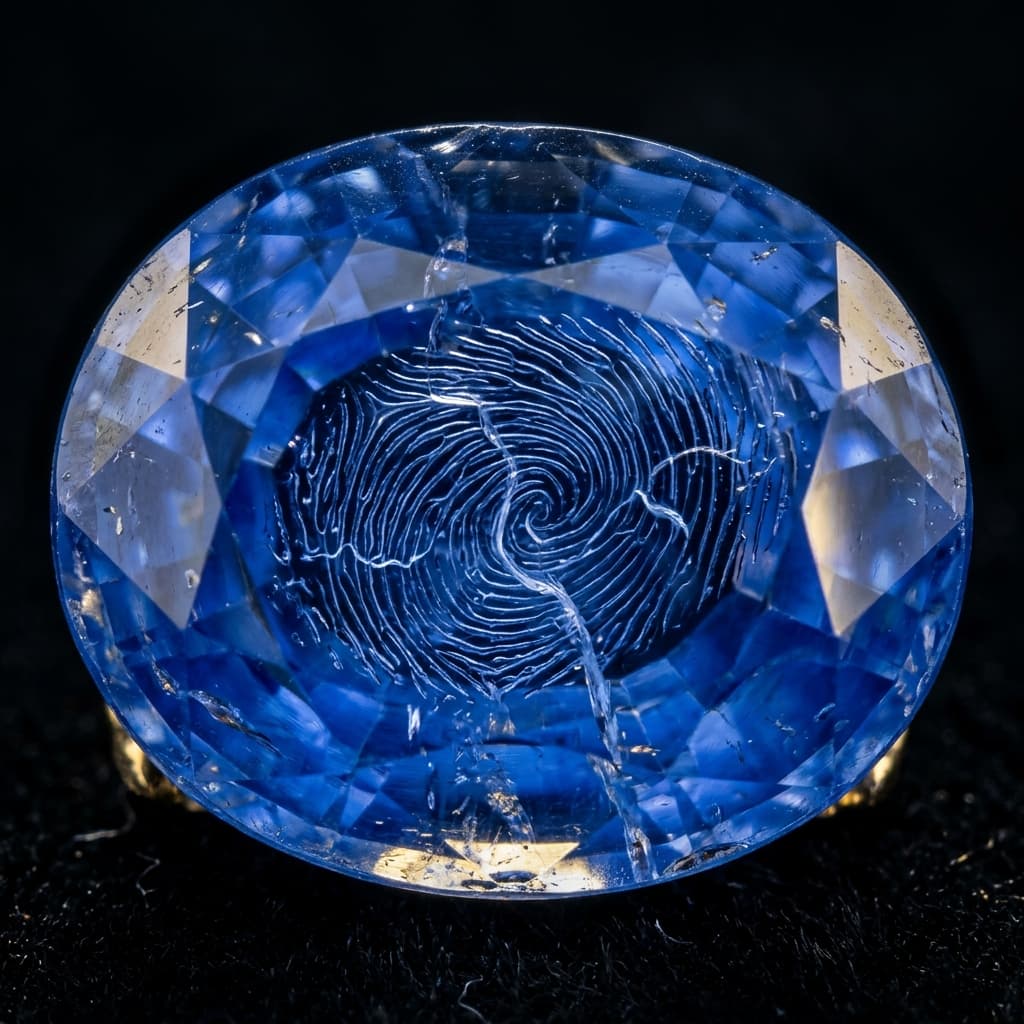
To the untrained eye, a gemstone is just a beautiful ornament. To a mineralogist, it is an archive of planetary evolution. Within the crystals of Ceylon sapphires lies a record of Sri Lanka's metamorphic history, dating back to the late Neoproterozoic era.
By studying these inclusions, we can reconstruct the temperatures, pressures, and chemical environments that existed miles below the Earth's surface hundreds of millions of years ago.
The Science of Silk The fine, needle-like inclusions frequently observed in sapphires are composed of rutile (titanium dioxide, TiO₂). These needles grow along specific crystallographic directions of the host sapphire. Under a microscope, they look like intersecting lines of delicate embroidery.
These needles are crucial for several reasons: 1. **Light Scattering:** They are responsible for the velvety appearance of the finest Ceylon sapphires. 2. **Authenticity Proof:** Because rutile melts at a lower temperature than sapphire, the presence of intact, sharp rutile needles proves that the sapphire has not been subjected to high-temperature heat treatment. 3. **Asterism:** If the silk is dense enough and the sapphire is cut as a cabochon, these needles reflect light to create a six-rayed star (star sapphire).
Halos and Radioactive Footprints One of the most fascinating features found in unheated sapphires is the zircon halo. Zircon crystals often contain trace amounts of radioactive elements like uranium and thorium. Over millions of years, the radioactive decay of these elements emits alpha particles, which damage the surrounding sapphire crystal structure.
This radioactive damage creates a circular zone of stress and discoloration known as a "pleochroic halo" or a "radiation halo." These halos are miniature geologic clocks, proving both the immense age of the gemstone and its natural, unheated state.
Fluid Inclusions: Ancient Atmospheres Perhaps the most incredible inclusions are "two-phase" or "three-phase" inclusions. These are microscopic cavities within the sapphire that contain liquid (often water or carbon dioxide) and a gas bubble. Sometimes, a tiny solid mineral crystal is also present.
These fluids are samples of the actual hydrothermal solutions from which the sapphire grew. When you hold a sapphire with a fluid inclusion, you are looking at a water droplet or a pocket of carbon dioxide that has been sealed since the Precambrian era. It is a direct sample of our planet's ancient atmosphere and chemistry.
Rather than flaws that detract from a gemstone, these features are invaluable scientific treasures. They are the credentials of the Earth.